
Amazon DSP Peak Season: How to Prepare Your Delivery Business for the Busiest Time of the Year

Peak Season is coming and for Amazon Delivery Service Partners (DSPs), preparation can make the difference between simply getting through the season and running a strong, organized operation.
As customer demand increases during major shopping and holiday periods, DSP owners may face greater pressure across driver staffing, dispatch, route monitoring, fleet operations, payroll, HR, and daily management.
Amazon itself describes Peak as its busiest time of year and has highlighted the importance of staffing, driver well-being, safety, technology, and operational preparation during this period.
For DSP owners, the time to prepare is before Peak not when Peak is already underway.
What Is Amazon DSP Peak Season?
Amazon DSP Peak Season refers to the periods when delivery demand increases significantly, particularly around major shopping and holiday events.
During these periods, DSP owners may have to manage:
Increased delivery volume
More drivers and routes
Higher operational activity
Additional hiring requirements
Greater dispatch workload
More vehicle utilization
Increased driver communication
More operational exceptions
Greater management pressure
Amazon's DSP program is designed around independent businesses that hire and manage their own drivers, while Amazon provides infrastructure, technology, and other support.
That means DSP owners remain responsible for running their business effectively, making preparation especially important.
Why Peak Season Preparation Matters
Peak Season doesn't simply mean more packages.
It can mean more moving parts across your entire operation.
A DSP that normally manages its operations comfortably may experience additional pressure when route volume, staffing requirements, driver communication, and fleet activity increase.
Amazon has noted that major shopping events require preparation months in advance, including staffing, training, safety planning, and detailed operational playbooks.
For DSP owners, preparation should therefore begin with four core areas:
People
Do you have enough qualified drivers and operational staff?
Dispatch
Can your team monitor routes and support drivers throughout the day?
Fleet
Are your vehicles prepared for increased utilization?
Administration
Can your HR, payroll, accounting, and reporting processes handle the additional workload?
1. Start Hiring Before Peak Season
One of the biggest challenges during Peak can be maintaining adequate staffing.
Hiring should not begin only when you realize you are short on drivers.
A strong Amazon DSP Peak Season hiring strategy should include:
Recruiting early
Maintaining a candidate pipeline
Faster applicant screening
Background-check coordination
Drug-test coordination where applicable
Employee onboarding
Training scheduling
Attendance planning
Backup staffing plans
The objective is to enter Peak with a prepared workforce rather than an emergency hiring requirement.
Amazon's own preparation for major shopping events emphasizes staffing and training ahead of time.
2. Strengthen Your DSP Dispatch Operations
During Peak, dispatch can become one of the most important parts of your daily operation.
More routes and drivers mean more information to monitor.
Your dispatch team may need to track:
Driver progress
Route status
Delivery issues
Driver questions
Operational delays
Rescue requirements
Vehicle problems
Escalations
End-of-day performance
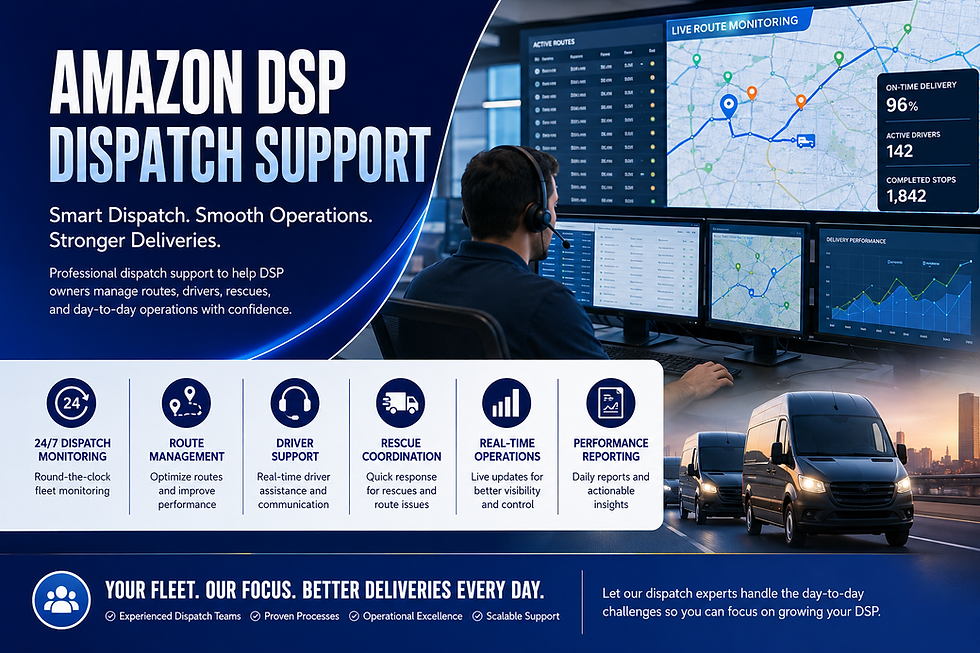
A professional Amazon DSP dispatch support team can provide additional operational capacity and help management maintain visibility across the fleet.
A DSP owner should ask:
If several drivers need assistance at the same time, is our dispatch operation prepared to respond?
If the answer is uncertain, now is the time to strengthen the process.
3. Prepare Your Fleet for Higher Utilization
Peak Season can place additional demands on vehicles.
Before Peak begins, review your fleet management process.
Consider:
Preventive maintenance
Vehicle inspections
Tire condition
Brakes
Lights
Heating and cooling systems
Vehicle availability
Maintenance scheduling
Backup vehicle planning
Vehicle documentation
Driver safety should remain a priority regardless of delivery volume.
Amazon has highlighted vehicle readiness, weather preparation, and driver safety as important parts of DSP operations.
A vehicle that is unavailable can affect more than one route it can affect your entire day's operation.
4. Don't Let Payroll Become a Peak Season Problem
More drivers and additional staffing activity can increase administrative work.
Payroll needs to remain:
Accurate
Timely
Organized
Properly documented
DSP owners should make sure their payroll process can handle changes in workforce size and workload without creating unnecessary administrative pressure.
Professional DSP payroll support can help management organize payroll processing while allowing owners to focus on operations.
5. Keep HR Organized
Peak Season can bring more hiring, onboarding, employee communication, and workforce administration.
A structured HR process can help DSPs manage:
Recruitment
Candidate screening
Onboarding
Employee documentation
Attendance
Workforce communication
Performance tracking
Employee records
Technology can also make HR processes more organized.
For example, New Fleet Solutions provides AI-powered HR technology designed to help streamline workforce management and improve visibility.
6. Monitor Your Routes Throughout the Day
Peak operations should not be managed only by looking at the final numbers.
Real-time visibility can help management identify potential issues earlier.
A dispatch team should be able to identify:
Who is on route?
Who may need support?
Which routes require attention?
Where are operational delays developing?
Which drivers may need assistance?
This is where professional route monitoring and DSP dispatch support can provide additional value.
7. Have a Rescue Strategy
During busy periods, unexpected operational issues can happen.
A driver may experience:
Vehicle problems
Route delays
Access issues
Unexpected operational challenges
Difficulty completing the route
A structured rescue process can help your team respond more efficiently.
The key is not simply having people available to help.
It is having a clear process for identifying, communicating, coordinating, and resolving operational issues.
8. Use Data to Manage Peak Season
Peak Season generates a large amount of operational information.
Instead of simply collecting data, DSP owners should use it to identify trends.
Consider monitoring:
Route performance
Driver attendance
Driver performance
Rescue frequency
Vehicle availability
Operational exceptions
Staffing levels
Payroll information
Daily performance trends
Amazon has increasingly emphasized technology and AI tools to help DSPs analyze business performance and operational information.
For DSP owners, better data visibility can support better operational decisions.
9. Don't Wait Until Peak to Fix Your Processes
One of the biggest mistakes a DSP can make is trying to build its operational system during Peak Season.
Instead, use the weeks before Peak to ask:
HR
Do we have enough drivers?
Dispatch
Can we monitor and support every route effectively?
Fleet
Are our vehicles ready for increased utilization?
Accounting
Can our payroll and accounting processes handle increased activity?
Management
Who handles an issue when the owner isn't available?
If any answer is unclear, it is an opportunity to strengthen your operation before demand increases.
How New Fleet Solutions Can Help DSP Owners During Peak Season
Peak Season requires more than drivers and vehicles.
It requires people, processes, technology, and operational support working together.
That's where New Fleet Solutions can help.
We provide integrated support across four key areas:
HR & Recruitment
Build your workforce before Peak with:
Driver Recruitment
Candidate Screening
Onboarding
HR Administration
Employee Support
Accounting & Payroll
Keep your financial operations organized with:
Payroll Processing
Bookkeeping
Invoice Validation
Financial Administration
Reporting Support
Dispatch Support
Keep your daily operations moving with:
Route Monitoring
Driver Communication
Dispatch Support
Rescue Coordination
Operational Monitoring
Reporting
Fleet Management
Improve visibility across your fleet with:
Vehicle Monitoring
Driver Performance
Fleet Operations
Maintenance Coordination
Fleet Reporting
Performance Tracking
Powered by AI Technology
New Fleet Solutions combines professional teams with technology designed to support modern DSP operations.
AI HR Software
Designed to help DSPs streamline workforce processes, improve hiring visibility, and organize employee management.
AI FleetOps Pro
Our dispatch and fleet operations technology is designed to help provide better operational visibility and support smarter fleet management.
People + Technology + Process = Stronger DSP Operations.
Your Peak Season Checklist
Before Peak Season begins, make sure your DSP has:
☑️ A strong driver hiring pipeline
☑️ Backup staffing plans
☑️ Organized onboarding processes
☑️ Reliable dispatch coverage
☑️ Route monitoring procedures
☑️ A rescue coordination process
☑️ Vehicle maintenance plans
☑️ Backup vehicle planning
☑️ Accurate payroll processes
☑️ Organized HR documentation
☑️ Daily performance reporting
☑️ Clear escalation procedures
The goal isn't simply to survive Peak.
The goal is to enter Peak prepared.
Final Thoughts
Peak Season can be one of the most demanding periods for an Amazon DSP.
But with the right preparation, processes, people, and technology, DSP owners can approach the season with greater confidence.
From driver recruitment and HR to dispatch, fleet management, payroll, and accounting, every part of your operation needs to be ready. And preparation shouldn't start when the first Peak route leaves the station.
Ready for Peak Season?
New Fleet Solutions helps DSP owners strengthen the operations behind their business with professional HR, Accounting, Dispatch, and Fleet Management support.
Prepare Early. Operate Smarter. Scale With Confidence.
New Fleet SolutionsHR | Accounting | Dispatch | Fleet Management


Comments